15 Best Things to Do in Durres, Albania
Durrës is where Albania's history meets its busiest stretch of coast. Founded by Greek colonists as Epidamnos and later the Roman port of Dyrrachium, it still has a Roman amphitheatre wedged between apartment blocks, Byzantine walls running past cafés and a seafront promenade that fills with people every summer evening. It is also about 33 km from Tirana and roughly 30 minutes by road from the international airport, so it works well as a first or last stop on any Albania trip.
This guide to the best things to do in Durres (or Durrës, as Albanians write it) is grouped by area: historic sights in the centre, the seafront, the beaches and two day trips beyond the city. That way you can see at a glance what is a short walk and what needs a car or a tour. For local businesses and services, see our Durrës city guide.
Historic sights in Durrës city centre
The first eight places to visit in Durrës sit within roughly 10 to 15 minutes' walk of each other, so you can link them on foot.
1. Durrës Amphitheatre
The amphitheatre is the reason many people come. Built in the early 2nd century AD under Emperor Trajan, it held around 15,000 to 20,000 spectators and is usually described as the largest Roman amphitheatre in the Balkans, according to the Municipality of Durrës. Houses still stand on the slope above, so only part has been excavated. Walk through the vaulted tunnels and find the small early Christian chapel built into the structure, with its wall mosaics.
- Time needed: 45 minutes to 1 hour.
- Tickets: around 300 lek at the time of writing, sold on site; bring cash. Hours change with the season, so check on the day.
- Local tip: go early in summer for cooler air and fewer people. The street above the site gives a free view down into the arena.
2. Durrës Archaeological Museum
Albania's largest archaeological museum reopened on 28 April 2026 after a full restoration under the EU-funded EU4Culture programme, repairing damage from the 2019 earthquake. Roughly 3,000 artefacts trace the city from prehistory to the Middle Ages, including finds from the Artemision of Epidamnos-Dyrrachium and the Beauty of Durrës mosaic. The restoration also improved accessibility for visitors.
- Time needed: 1 to 1.5 hours.
- Tickets and hours: not yet published in a reliable source since the reopening. Older guides quote pre-renovation times, so confirm locally.
- Local tip: visit before the amphitheatre; the objects make the ruins far easier to read.
3. Venetian Tower
This round 15th-century tower, built by Venice on Byzantine foundations to guard the harbour, marks the start of the seafront. After restoration in 2022 and 2023 it became Albania's first Heritage Interpretation Centre, telling the city's story through VR headsets, audio guides and dome projections. Narrow, steep stairs inside lead to views over the port and the Adriatic.
- Time needed: 30 to 45 minutes.
- Accessibility: the stairs make the upper level unsuitable for wheelchair users.
- Local tip: several free, tip-based walking tours start nearby, which is an easy way to hear the stories behind the stones.
4. Byzantine city walls and the old town
Emperor Anastasius I (491 to 518), who was born here, rebuilt the city walls after an earthquake. Long sections still stand between the Venetian Tower and the amphitheatre, later reinforced by Charles of Anjou, the Venetians and the Ottomans. Follow them through the old quarter and look for the Clock Tower, part of the later Ottoman wall.
- Time needed: 30 to 45 minutes as a walk.
- Cost: free to view from the street.
5. Byzantine Forum and Roman Baths
In the centre, a ring of marble columns marks the Byzantine Forum, also called the Rotunda: the circular market square of 6th-century Dyrrachium. It is open-air and free. A few steps away, beneath the Aleksandër Moisiu Cultural Centre, lie Roman baths with a black-and-white chessboard marble floor.
- Time needed: 15 to 20 minutes.
- Good to know: access to the baths has been limited during renovation of the Cultural Centre, so you may only see them from outside.
6. Fatih Mosque and the Great Mosque
The Fatih Mosque, built in 1502 to 1503 just after the Ottoman conquest, is one of the oldest Islamic buildings in Albania. Its tiled roof, rather than a dome, makes it unusual. On the main square, the Great Mosque dates from 1938; its dome and minaret were removed in 1967 under communism, and it returned to worship in the 1990s.
- Time needed: 20 to 30 minutes for both.
- Etiquette: both are active mosques. Dress modestly, remove your shoes and avoid prayer times.
7. Ethnographic Museum (Aleksandër Moisiu House)
This 19th-century house of stone and wood, with a traditional veranda, was the childhood home of Aleksandër Moisiu (1879 to 1935), a celebrated actor on the European stage. Closed after the 2019 earthquake, it reopened in June 2026 after EU4Culture restoration. Rooms show household objects, gold-thread embroidery and copperware, with a section on Moisiu's career.
- Time needed: 30 to 45 minutes.
- Tickets and hours: check locally; they were not published at the time of writing.
8. King Zog's Villa viewpoint
On the hill above the centre stands the Royal Villa, completed in 1937 as King Zog's summer residence. The building is closed to the public, but the area around it is one of the best viewpoints over the bay, port and old town, particularly in the late afternoon.
- Time needed: about 45 minutes including the climb.
- Getting there: a steep 15 to 20 minute walk uphill from the centre via Rruga Kont Urani, or a short taxi ride.
- Expectation: you are coming for the view, not the interior.
Seafront, food and Durrës at night
9. Walk the Vollga Promenade at sunset
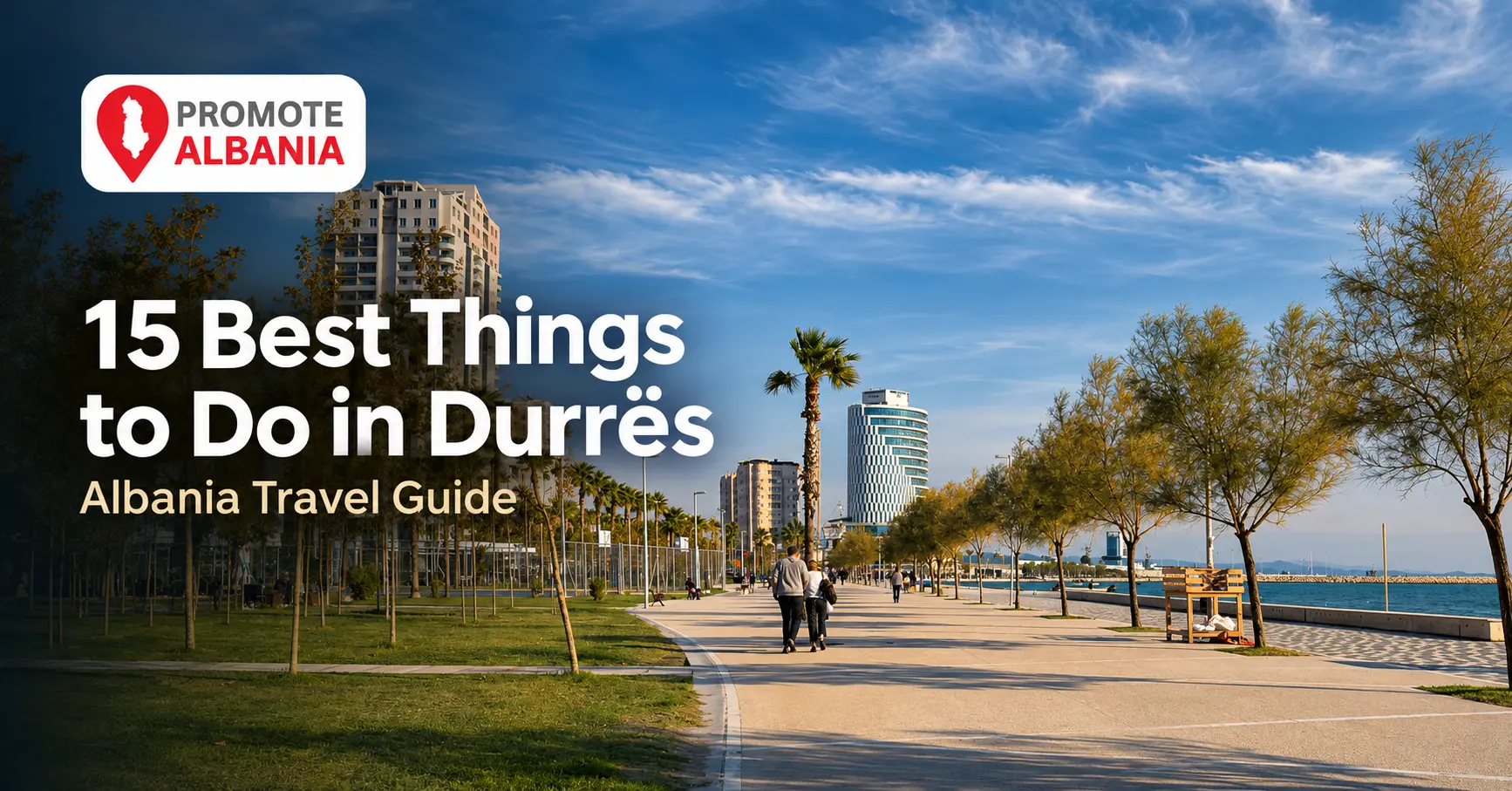
The seafront promenade, known locally as Vollga, runs from the port area along the bay towards Currila. It is where the city gathers in the evening for the xhiro, the traditional evening stroll, while the sun drops into the Adriatic. Palm trees, benches, play areas and cafés line the way.
- Time needed: 1 to 2 hours, longer with dinner.
- Cost: free.
- Local tip: arrive about an hour before sunset in summer, when seaward benches fill quickly.
10. Eat fresh seafood and Albanian dishes
As a port city, Durrës does seafood well: grilled fish, octopus, mussels and calamari appear on most waterfront menus. For Albanian staples, look for tavë kosi (baked lamb with yoghurt), fërgesë and fresh byrek from bakeries. Prices are usually higher on the promenade than in the old town's side streets.
- Local tip: ask the price of fish by weight before you order the catch of the day.
- Find a table: browse restaurants and cafés in the PromoteAlbania directory.
11. Experience Durrës at night
Most things to do in Durrës at night revolve around the seafront. In summer, promenade cafés and bars stay busy late, and beach bars south of the port add music. Albanian coffee culture means there is always somewhere for an espresso or a drink with a sea view. Outside high season the city is much quieter, and some beach bars close.
- Good plan: sunset walk, seafood dinner, then a drink on the waterfront.
Durrës beaches
12. Currila and Kallm beaches
Currila, about 2 km north-west of the centre, is the traditional locals' beach: a small, busy cove with cafés at the far end of the promenade. For clearer water, continue to Kallm, about 4 km out, where the coast turns rocky with boulders in the shallows.
- Best for: a quick swim without leaving the city.
- Local tip: pack water shoes for Kallm.
13. Durrës Beach, Shkëmbi i Kavajës and Golem
The long sandy Durrës beaches begin south of the port, not in the old centre. Plepa (about 5 km), Shkëmbi i Kavajës, named after the Kavaja Rock (15 to 20 minutes by car), and Golem (about 10 km south) form a near-continuous strip of sand with hotels, sunbeds and beach bars. Golem's fine sand and shallow water suit families.
- Getting there: taxi, car or local bus; this is not walking distance from the amphitheatre.
- Local tip: in July and August, arrive before 10 am for a good sunbed.
- Expectation: these beaches are crowded in peak season, and water near the port can be less clear than further south.
Day trips outside Durrës
These two experiences are outside the city and need transport.
14. Cape of Rodon and Skanderbeg's Castle
About an hour's drive north of Durrës, the Cape of Rodon is a narrow peninsula with the ruins of a castle Skanderbeg built around 1450 to 1452, the Church of St Anthony and quiet coves. Coastal erosion has left parts of the walls in the sea, which makes for striking photographs.
- Getting there: there is no public transport to the cape. Arrange car rental in Durrës or a tour through a local agency such as Eni Travels.
- Time needed: half a day to a full day.
- Local tip: wear sturdy shoes; the paths are short but uneven.
15. Day trip to Tirana
Albania's capital is about 33 km away and roughly 35 to 40 minutes by bus from Durrës' intercity bus station, traffic permitting. Spend the day around Skanderbeg Square, the museums and the cafés of the Blloku district for a contrast with the coast.
- Time needed: a full day.
- Good to know: the Tirana to Durrës railway is being rebuilt, and passenger trains are not expected before 2027.
Best time to visit Durrës
June and September offer the best balance: warm sea, long evenings and fewer crowds than midsummer. July and August are peak season, with hot days, packed beaches and busy roads to the coast. April, May and October are ideal for sightseeing in comfortable temperatures, though the sea is cooler and some beach businesses close outside summer. Winter is mild and quiet, fine for history but not for swimming.
How many days do you need in Durrës?
One full day covers the historic centre and a sunset on the promenade. Two days lets you add a beach day. With three days you can fit in the Cape of Rodon or Tirana.
How to get around Durrës
- On foot: the amphitheatre, museums, Venetian Tower, forum, mosques and promenade are all close together.
- Taxi: useful for King Zog's Villa, Currila and the southern beaches. Agree the fare or check the meter before you set off.
- Bus: buses to Tirana leave from the intercity bus station near the port. An airport bus links the station with Tirana International Airport roughly every two hours, taking about 35 minutes.
- Car: the easiest way to reach the Cape of Rodon and quieter beaches further south.
- Arriving by ferry: Durrës port has ferry links to Italy. Eni Travels books ferry, bus and flight tickets, and Luggage Storage Durrës near the port lets you leave bags and explore before your onward journey.
- Train: no passenger trains currently run between Durrës and Tirana.
Where to stay in Durrës
- City centre and promenade: best for first-time visitors without a car, with sights, restaurants and the evening xhiro on your doorstep.
- Durrës Beach (Plepa and Shkëmbi i Kavajës): beachfront hotels and apartments for a seaside stay; you will need a taxi into the centre.
- Golem: a resort strip about 10 km south, popular with families.
For self-catering, Dream Stay Durrës offers furnished one- and two-bedroom apartments near the beach, suited to couples and families.
Where to eat in Durrës
- Promenade and port area: seafood with sea views, at higher prices.
- Old town around the amphitheatre: smaller family restaurants, bakeries and cafés for a cheaper lunch.
- Near the beach: casual grills and pizzerias such as Antika Pizza, a family-friendly spot near Durrës Beach for an easy dinner after a day on the sand.
Carry some cash, as smaller places may not take cards.
One-day Durrës itinerary
- Morning: Archaeological Museum, then the amphitheatre before the midday heat.
- Late morning: Fatih Mosque and the Ethnographic Museum in the old quarter.
- Lunch: a family restaurant or byrek bakery in the old town.
- Afternoon: Byzantine Forum, the city walls and the Venetian Tower, or a swim at Currila in summer.
- Late afternoon: walk up to King Zog's Villa for the view.
- Evening: sunset on the Vollga Promenade, a seafood dinner and a drink on the waterfront.
Durrës FAQ
Is Durrës worth visiting?
Yes, especially if you want history and the sea in one place. Few cities let you see a Roman amphitheatre, Byzantine walls and a beach in the same afternoon. Set realistic expectations, though: Durrës is a working port city, and its central beaches get crowded in summer.
Can you explore Durrës in one day?
Yes. The main sights are compact and walkable, so one well-planned day covers the amphitheatre, the museums, the Venetian Tower and a sunset on the promenade. Add a second day for the beach.
What is Durrës best known for?
Its Roman amphitheatre, its long history as ancient Dyrrachium, its role as Albania's main port and its sandy beaches south of the city.
What are the best beaches in Durrës?
Currila is the handiest for a quick swim from the centre, and Kallm has clearer water. For long sandy beaches, head south to Plepa, Shkëmbi i Kavajës and Golem.
How far is Durres from Tirana and the airport?
Tirana is about 33 km away, around 35 to 40 minutes by bus. Tirana International Airport is roughly 30 km away, about 30 minutes by car, and an airport bus runs to Durrës bus station roughly every two hours.
Is there a train from Tirana to Durrës?
Not at present. The line is being rebuilt with a new branch to the airport, and electric passenger services are planned to begin in 2027.